Differentiation is dead, long live differentiation
I asked eleven AI models from three vendors for a complete go-to-market strategy. Same open question, no constraints. Eleven strategies came back; in practice, one document, priced at the market's existing midpoint. This part runs that experiment, checks the advice against Stockholm's actual bakeries, and follows the result to the only dividing line that holds: the models are exceptional in production, and empty at the exact point where strategy is decided. Differentiation is dead, if you ask the machine for it. Long live differentiation, because most of your competitors just did.
Somewhere around the London Olympics, colleagues at Vizeum showed me research that has stayed with me ever since. They had tested TV commercials from the big television manufacturers, Panasonic, Samsung, Sony, with one small edit: the end frame removed. Consumers watched the films and guessed who made them.
They could not tell. There was no correlation between what an ad looked like and which brand people guessed was behind it. These companies bought some of the most expensive airtime on earth, and the communication itself carried no trace of who was speaking.
I wish I could say this was an outlier. An Opinium survey in June 2012 found Samsung and Panasonic "yet to be fixed in the minds of UK consumers" despite sponsoring the Games, and in a Research Now poll more than half of respondents named Nike as a sponsor. Nike was not one.¹ Ehrenberg-Bass, the research institute much of modern marketing leans on, later put a number on the general case: of 143 TV ads tested, only 16 percent were both remembered and attributed to the right brand. When people misattribute, the credit tends to go to the category leader.²
Keep that scene in mind. Everything below is about what happens when you industrialise it.
The question
I know I am not the first to point out that AI output converges. The models give you the most probable answer, because that is what they are built to do. I have written about the mechanics before, so I will not repeat them here.
The interesting question sits one level up: what is AI actually worth strategically in a world where a company's existence still hangs, to a large degree, on differentiation?
I got curious enough to run an experiment. One open question, eleven models, three vendors. Eleven complete go-to-market strategies came back. In practice, one document. The numbers are below. First, though, a quarrel needs clearing out of the way.
The quarrel I am not going to join
Marketing has spent years in a trench war over this. Byron Sharp's camp, armed with Ehrenberg-Bass data, says differentiation is overrated: build distinctive assets instead, own a colour and a shape and a sound, and be mentally available when the buying moment comes. Mark Ritson's camp insists differentiation is alive and still carries the weight.
I think they are arguing about layers of the same thing. The Sharp side will object that distinctive assets are deliberately meaningless, built for recognition rather than persuasion, and that is precisely their point. But zoom out to the level of the firm and the choice to compete on recognition still answers the only question differentiation ever asked: how do I stand apart from my competitors? When two products are near identical, Coca-Cola against Pepsi, one TV panel against another, being unmistakably yourself is what makes you choosable. Distinctiveness, as I read it, is differentiation applied to the communication layer. The broader concept covers the offer, the model, the experience. The narrow one covers how you are recognised. Same war, different trenches.
Sony understood the layered version in 2005, in exactly the category from my opening scene. David Patton, who ran Sony's European marketing, described the problem as a "lack of perceived differentiation" in a market of comparable quality and strikingly similar design. The answer became BRAVIA: a quarter of a million rubber balls bouncing down a San Francisco street to a José González track, under the line "Colour like no other". The year after, Sony passed Sharp as the world's biggest LCD brand.³ In a category where nobody could tell the products apart, the expression itself did the differentiating.
That was the communication layer doing the work. Mats Georgson's growth data shows the offer layer doing the same job. He studied 150 companies that grew, in his words, by an average of 860 percent over ten years, and found that advertising was not the main vehicle for most of them. His explanation is that they combined customer demands into offers so distinct, he calls the combinations demand point constellations, that people simply started talking about them.⁴ The talkability was the effect. The differentiation, in the offer itself, was the cause.
One caveat belongs here, and it is the strongest card in the reach deck: you can build the best, most sharply differentiated product in the world and still die because not enough people ever hear of it. It may be the most common way good products fail. Sundar Swaminathan, who ran brand marketing science at Uber, shared a curve that makes the point. Unaided awareness for Uber Eats in the UK sat at 40 percent, rose to 55 during a brand campaign, and slid straight back to 40 when Uber paused the campaign.⁵ Memory leaks. I live in Barcelona and take FREENOW, not because I compared taxi apps but because it is the one I see constantly in the streets and in my head. So no, this is not an argument against reach. Georgson calls advertising a multiplier rather than an engine, and I think that is exactly right. Differentiation is the engine. You need both, and neither can do the other's job.
The experiment
Here is what I ran. One open question:
"We are a small Swedish company about to launch a new product: a premium cinnamon bun, sold by the piece. Develop a complete go-to-market strategy for us for the Swedish market. You will not be able to ask any follow-up questions, but we still expect a full strategy in return."
No format requirements, no word limit. Eleven models from three vendors, spanning four generations, from models that answered in seconds to a flagship reasoning model that thought for seventeen minutes and thirty-seven seconds.⁶
All eleven chose the same target audience: urban quality-seekers, 25 to 55, big cities. All eleven built the same positioning story: craft, real butter, the Swedish institution of fika. All eleven landed their price points within the same narrow span of one another. All eleven proposed specialty cafés plus office fika as the channel architecture, rolled out in phases. All eleven wanted to send free buns to food journalists and influencers. No one asked for this structure. No one deviated from it.
The counting gets more interesting where the models disagree. Across the eleven answers I found 35 ideas that only a single model proposed. That sounds like healthy diversity until you sort the ideas by what they touch. Fifteen concern method and verification: kill rules, pre-mortems, compliance checklists, a RACI table. Eight are communication mechanics, six are operational policies. Exactly two touch the position itself, and zero propose a different audience or a different price. Run a strict test of which unique ideas would survive as an actual reason to choose this company over the incumbents, and roughly five of the thirty-five remain. The uniqueness lives almost entirely in how to execute and verify the same plan.
Then there is the price. The median across eleven models was 49 kronor. The model that landed on 49 in seconds cited no sources at all. The one that landed on 49 after seventeen minutes of reasoning brought thirteen citations, including a survey of actual Stockholm bun prices. Same number, roughly seventy times the effort between the extremes. All that extra thinking bought rigour and ways to check the plan. It did not buy a different position. None of the eleven calculated a price; they read the market's existing midpoint back to me.
The second convergence
It gets worse, or better, depending on where you sit. The strategies do not just converge with each other. They converge with the market that already exists.
The positioning language the models produced, hand-craft, real butter, sourdough, long fermentation, is close to a transcription of what Stockholm's established premium bakeries already publish on their websites. The 49-kronor median lands three kronor above Vete-Katten's listed counter price, and Vete-Katten has sold buns in Stockholm since 1928.⁷ All but one of the eleven proposals sit inside the existing big-city bakery price band, in its upper half. A price adjustment, dressed as a position.
Follow the consensus advice and you are applying for membership of the market, at market price.
Two footnotes from the analysis sharpen the picture. The models did find one genuine gap: e-commerce and office subscriptions, which the real bakeries barely serve. But all eleven found the same gap. A white space that every user of the same tool can see is not a white space, it is a queue. And no model addressed the asset that empirically decides this category: external canonisation. Blind-test wins, awards, decades of institutional history. The map contains what has been written about the category. What actually decides it was never written down as advice.
Why it cannot be otherwise
None of this is a defect. A language model returns the modal answer, the probability-weighted centre of everything written about a subject. That is the product working as designed. I ran five separate analyses over the eleven answers, from set overlap to semantic embeddings to classical brand frameworks, and they all land in the same place; two models even produced, word for word, the same "unique" positioning line.⁸
This is why consensus output and distinctiveness are logically incompatible. Whatever eleven models propose, or eleven competitors each asking their own model, cannot be owned by any of them. Ask a machine for a differentiation strategy and you receive the category's self-image, which is the one thing a brand can never own. You are paying to build the category leader's memory structures. Auditing the eleven answers through Sharp's own distinctive-asset lens confirms it from the other direction: category codes everywhere, almost nothing a brand could own.
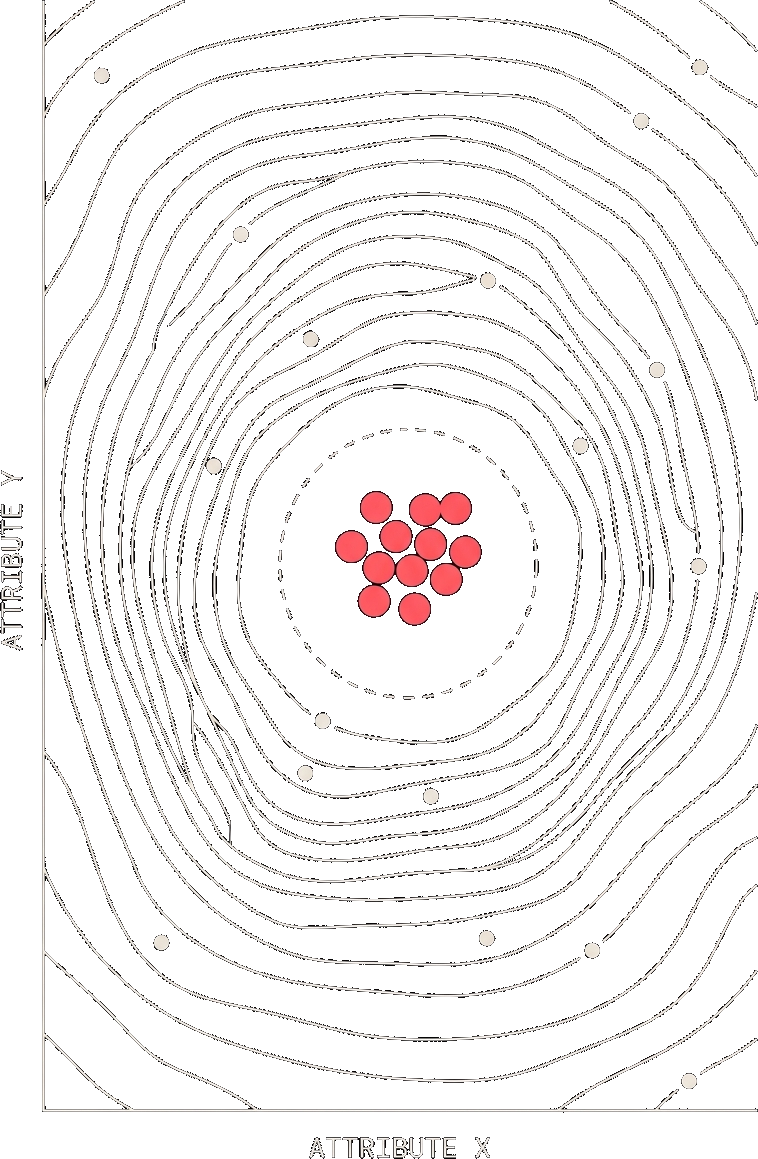
Georgson has a metaphor for the generic: a gravity well that pulls brands into orbit and slowly down. My experiment is what that looks like measured. Eleven strategies, one well, all circling 49 kronor. The new demand his growth cases were built on hides in workarounds and unmet moments that nobody has written up yet. The machine, by construction, only knows what the witnesses already said.
Long live differentiation
So here is the thesis, in both halves.
Differentiation is dead, in one specific sense: everyone who leans on an LLM to create their differentiation will converge. The tool that promises to make you distinct delivers the market's average, and delivers it to all your competitors at the same time. LLM-made differentiation kills itself.
Long live differentiation, because real differentiation still takes market share, and always will. When a large part of the market starts drafting its strategy from the same probability machine, the field opens for anyone willing to go where the map ends. It has never been cheaper to look different from companies who all bought the same middle: their shortcut is your opening.
The nuance is that differentiation was never one thing. A carpenter or a hairdresser does not differentiate much in the classic sense; the edge lives in proximity and reputation, which is why every dying town still has a hairdresser. In pure generics, communication is the whole game. Here in Spain I buy Mercadona's own lemon soda over Fanta Limón; the Fanta costs more than twice as much per can, 80 cents against 37. Could I taste the difference if I lined them up? Probably. Do I, grabbing a cold can from the fridge? No. Is that worth double? No. The Mercadona brand is called Fresh Gas, a name I suspect was never tested on English speakers, and it holds its shelf space fine. And for a consultancy whose service travels, competitors are everywhere and differentiation is the condition for existing at all. I recently reviewed an agency that wanted premium fees while packaging itself as available, communicative and on the ball. Nice qualities. They describe a good waiter. Nothing in the packaging showed the value created, so nothing justified the price. They are not alone.
How I actually use the machine
In case this reads like a man yelling at probability clouds: I use these models daily, including for strategy work. On a recent strategy assignment for a real-estate agency in Spain, I wrote the first draft of the positioning myself. Then I set up eight to ten different lenses, brand strategists of different schools, growth architects, management consultants, three buyer perspectives, and let them attack the draft. Ten iterations later, on top of the research and the data, we had a strategy I was prepared to stand behind.
Note the order of operations. The direction came from me; the machine multiplied the perspectives challenging it. That is a different activity from typing "develop a strategy" into a chat window and receiving the category's average with confident formatting.
The dividing line to carry with you is production versus strategy. In production, the direction, the message and the expression are already set, and the models are exceptional there: quick, and they never tire. In strategy, the direction is the deliverable. Ask the machine for it and you get the middle of the map.
For the people setting direction
I will not give you a checklist by role and industry. A universal rule for applying AI would be the same disease this article describes: if everyone applies it, its value is gone. What holds is smaller, older, and almost embarrassing to type.
You will not get more out of the model than you put in. A generic question buys a generic answer, and the first answer is rarely the best one.
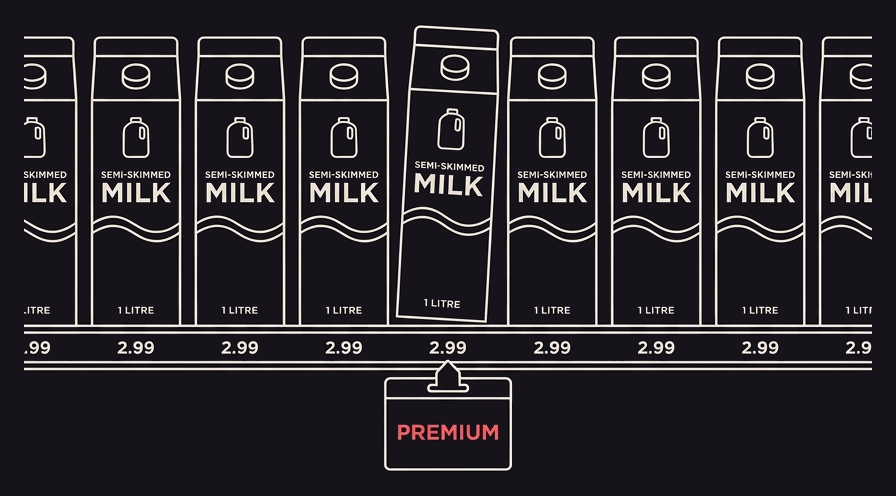
Let the models inform your strategy, your message, your differentiation. Never let them set any of it. They can hand you insight that makes your decision better; the decision that makes you distinct is not outsourceable to LLMs, and every company that outsources it anyway will converge on the same free middle. Semi-skimmed milk, as we say in Sweden (mellanmjölk, literally "middle milk": just one in the middle of many alike). The companies that put the machine to work inside a direction someone actually chose will win. And for everyone in marketing watching production work disappear, this is the good news: the models are coming for the production hours, and the production hours were never where the value sat. The ability to read a market and choose a position has a stronger business case than it has had in decades.
Coda
Those Olympic TV ads converged without a single language model. Human strategists with prime Olympic airtime produced communication nobody could tell apart. Sit with that. Convergence is a human default: give most people in most industries the same inputs and the same pressures, and we land in the same thoughts and call them conclusions. The models did not invent the middle. They automated our oldest habit and cut its price to zero.
Which is exactly why differentiation pays. It always demanded more than quick decisions and fast insight; it demands going further in the work than the consensus bothers to go, and the value on the other side is priced accordingly. The models can absolutely serve in that work. Expecting them to hand you differentiation on demand is expecting the middle of the map to point somewhere else.
It will not.
Q&A
- Wouldn't better prompting produce differentiated strategies?
- Better prompting produces better versions of the same strategy. The direction has to arrive with the prompt: the models sharpen a position you bring, and they multiply the perspectives challenging it, but the unserved demand a real position is built on is precisely what has not been written down yet, so it is not in the training data for any prompt to find. You will not get more out of the model than you put in, and a generic question buys a generic answer.
- Did the vendors differ? Would picking the right model fix this?
- Less than you would hope. The overlap between vendors was nearly as high as the overlap within them, and the models that deviated did so by disposition rather than by brand: the deviants made choices and exclusions where the rest made lists, and they deviated in the same direction as each other. Switching vendors moves you around inside the same map. It does not move the map.
- So should companies keep LLMs out of strategy work?
- No. The order of operations is the whole game. Write the position yourself first, then use the models to attack it from angles you could not staff: different schools of strategist, different buyer perspectives, round after round. That is what I do, and it makes the work faster and better. What fails is reversing the order, asking the machine for the position, because then you receive the category's average and pay to build the category leader's memory structures.
Notes and sources
- The Vizeum research itself was internal material I saw at the time; the public record is the checkable trace. Opinium Research, June 2012, on Olympic sponsor awareness (Samsung and Panasonic "yet to be fixed in the minds of UK consumers"); Research Now polling on London 2012 sponsor misattribution, in which a majority named non-sponsor Nike. Raw sources saved per file in the research archive.
- Ehrenberg-Bass Institute research on advertising attribution: of 143 tested TV ads, 16 percent were both remembered and correctly branded, and misattributed advertising tends to be credited to the category leader. Raw source in the research archive.
- Sony BRAVIA "Balls": first aired 6 November 2005 in a full ad break on Sky Sports before Manchester United–Chelsea; Fallon London, directed by Nicolai Fuglsig; roughly 250,000 bouncy balls on Filbert Street, San Francisco; soundtrack José González, "Heartbeats". The David Patton quote is from the D&AD case study of the campaign. Sony overtaking Sharp as the largest LCD-TV brand: industry sales reporting, 2006.
- Mats Georgson, "Epic Growth", a 115-page analysis published on LinkedIn: 150 companies with a minimum of 160 percent total growth over ten years (2012–2024), average 860 percent; his own study, offered in his words to explore rather than prove, not peer-reviewed research. Quotes and framing also from his EFN interview (September 2025) and The Push podcast, episode 63 (January 2026).
- Sundar Swaminathan, Uber's head of brand marketing science at the time, LinkedIn, August 2026: Uber Eats UK, 2020, measured with four brand-lift studies; unaided awareness 40 percent four weeks before launch, 55 at six weeks in, back to 40 at the twelve-week check after the campaign was paused. The episode moved Uber from campaign bursts to always-on brand investment.
- The eleven: Claude Haiku 4.5, Claude Opus 5 and Claude Fable 5 (Anthropic); Gemini 3.7 Flash, 3.6 Flash, 3.5 Flash, 3 Flash Preview, 2.5 Flash and 2.5 Flash-Lite (Google); ChatGPT 5.5 and ChatGPT 5.6 Sol, both at medium reasoning (OpenAI). August 2026, identical prompt as quoted in the body, one run per model with one exception: ChatGPT 5.6 Sol needed a second attempt after the first returned nothing at all in over fifteen minutes, which is a data point of its own. The fastest full answer took about fifteen seconds; 5.6 Sol took seventeen minutes and thirty-seven seconds.
- Prices: Vete-Katten's order page listed 46 kr in 2026 (founded 1928); Stockholm average 44 kr in 2025 per Sambla's survey; the big-city band of 39–56 kr spans Espresso House (39) to Bröd & Salt (56). Three of the six bakeries in the comparison publish no bun price; their positions in the figures are estimates and marked as such.
- The five analyses: tactic overlap (Jaccard over 84 canonical tactics; mean pairwise similarity 0.46, with vendor identity explaining almost none of it), semantic embeddings (mean pairwise cosine similarity 0.95 against a 0.73 floor for unrelated text), a value-curve comparison against six real Stockholm bakeries, a points-of-parity classification (88 percent of some 265 classified elements were category table stakes), and a distinctive-asset audit. The verbatim duplicate positioning line, "The Ultimate Fika Experience", appeared word for word in two generations of the same vendor's model family, Gemini 3.5 and 3.7 Flash. Full responses and all five analyses available on request. This article, for what it is worth, went through the same loop it describes: a written position first, then a panel of adversarial lenses set loose on it.